

Cloud computing technologies to form basis of new virtual design fab
 IBM (NYSE: IBM) and five leading Russian innovation companies: the Skolkovo Foundation, Rusnano, Rostelecom, Russian Venture Company and ITFY, have signed a collaboration agreement to help spur a new wave of innovation in Russian technology.
The five Russian companies have joined forces to foster a culture of applied research and commercialization and attract key talent and investment from around the world in the area of microelectronics.
Key to the initiative is the creation of a new Electronics Technology Center (ETC) to be housed at the Skolkovo Innovation City. The agreement will give the Electronics Technology Center access to IBM’s intellectual property for chip design. IBM will also provide cloud computing technologies to form the basis of a new virtual design environment to be used to develop new microelectronic devices such as sensors to be used in smarter infrastructure projects, industry and consumer electronics…
SHI International Goes Back to the Future with New Cloud Briefing Center
Grazed from Sys Con Media. Author: Elizabeth White.
 SHI International Corp. is going back to the future with its imaginative New York City Briefing Center, which was unveiled on Thursday at 1 Penn Plaza. The center is a futuristic office straight out of the pages of science fiction and delivers an immersive, interactive experience to give visitors a comprehensive view of SHI’s innovative cloud computing services, technologies, and capabilities.
The Briefing Center features bright white walls reminiscent of "2001: A Space Odyssey"; automatic glass doors that can transition from clear to opaque and even display images; and 3-D projectors that will put the world of traditional presentations to shame. A customizable 3-D tour of SHI’s cloud architecture creates an immersive experience from the moment visitors step through the door. It offers clients a look inside SHI’s next-generation data center and cloud solutions to help them find the best fit for their organization’s cloud computing needs…
Ushering in the Future with Cloud-Connected Backup
Grazed from The Var Guy. Author: Editorial Staff.
A recent survey by North Bridge Capital revealed that 50 percent of companies polled have “complete confidence” in cloud technology. That’s exciting news, but it also poses a challenge. After all, it means that the other 50 percent are not entirely convinced that cloud computing is a good for their business. Interestingly, only 3 percent of companies polled actually consider the cloud to be “too risky.” What that means for you is that a lot of your customers are in a gray area. They aren’t completely opposed to running business-critical applications in the cloud, but they also aren’t quite sure whether now is the right time or what the right products are.
For you, this is an opportunity to usher your customers into the future and increase your revenue stream by adding valuable cloud-connected services. In fact, cloud-connected services likely can alleviate a number of your customers’ operational pain points. Data backup and recovery is particularly ripe for innovation, since tape backup, a tedious and outdated process, is still used by many companies who simply aren’t up to speed on better options. These customers need a trusted adviser to help them move on. Explain the key benefits of a cloud-connected solution — scalability, mobility and infrastructure as a service — and you’ll be on your way…
Cloud Providers: The Case for Universal Standards
Grazed from The Wall Street Journal. Author: Charles Weaver.
With the adoption of cloud computing accelerating, there is now an urgent need for a globally accepted, universal standard and code of behavior for service providers delivering these solutions.
Today, the cloud is unregulated. It actually takes more licensing, oversight and continuing education to cut and style hair than it does to manage data in the cloud.
According to Ed Ferrara, principal security analyst with Forrester Research, “understanding the cloud provider’s underlying capabilities, resources, security processes and safeguards, as well as the provider’s overall financial health will be very important for organizations who want to safely and successfully utilize cloud computing.”…
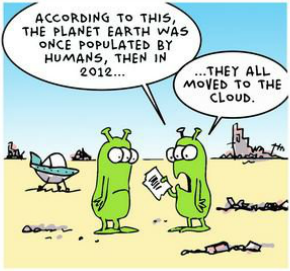
Mad Cow Friday: Moved to the cloud
This is a funny "cloud computing" comic clip that surfaced this week. Humans populated earth, but moved to the cloud in 2012. What’s next? Mars Computing? Saturn Computing? Enjoy.
The real obstacle to federal cloud computing
Grazed from FierceGovernmentIT. Author: David Perera.
The State Department, it turns out, has a cloud that’s not really a cloud.
When auditors from the office of inspector general took a look at the thing the department calls a cloud computing service, they decided it can’t be so, since it violates just about all of the five essential characteristics of a cloud, as defined by the National Institute of Standards and Technology.
Those five characteristics are on-demand self-service, broad network access, resource pooling, rapid elasticity and measured service…
Private Cloud: An IT Staffer’s Guide To Success
Grazed from NetworkComputing. Author: Joe Onisick.
Recently I wrote The Biggest Threat to Your Private-Cloud Deployment: Your IT Staff as a call to management to understand the importance of their IT staff and the changes that will be required to move to a cloud model. That post received some strong criticism from readers who took it as an attack on IT, which was not its intent. In this post I’ll cover the flipside of the coin, the IT staff perspective.
These issues are important because organizational changes are a pivotal part of cloud-based computing–the move to a service-focused model is just as much about people as it is about technology. I’ve written about this in a previous InformationWeek Report, The Human Factor in Private Cloud Deployments [free, registration required]…
Apacer Rolls Out SAFD 25A SSD For Cloud-Based Computing
Grazed from CDRLabs. Author: Editorial Staff.
 As cloud computing becomes a mainstream, it is essential for enterprise servers to improve capacities and data transmission speeds. Apacer is taking cloud computing as one of its core areas of development, and has created the SAFD 25A – a SATA 3.0 SSD that boasts both capacity and performance gains to address the needs of this industry. This is a high-end SSD targeted for cloud-based computing, featuring outstanding efficiency, based on high IOPs, and a large storage capacity of 512GB. It aims to optimize data storage variables in cloud computing centers by providing speed within a stable and power-saving operating environment.
By using the exceptional features of SSDs such as anti-shock, anti-vibration, low-power consumption, and high-speed data transmission, Apacer expects to help enterprise servers to improve their data access constraints and, in doing so, take the place of traditional hard drives. This can all be accomplished in tandem with cutting a large amount of the cooling cost, providing ground-breaking efficiency to create an increasingly reliable operating environment…
Cloud Computing Gets Bigger As Dropbox Doubles Capacity Of Online Storage
Grazed from International Business Times. Author: Valli Meenakshi Ramanathan.
 Cloud computing just got a shot in the arm as online storage service provider Dropbox decided to double the capacity of its offerings to consumers without hike in prices owing to intense competition and also offers a new 500GB service plan at $499 a year.
A report published in Computerworld cites how the company is under increasing pressure from competitors to offer additional capacity at its current pricing. Apart from traditional consumer online storage services such as SugarSync, Carbonite, Mozy, new deep-pocketed players in the arena including Microsoft, Apple and Google are forcing Dropbox to face the heat…
Cloud Computing: Can Microsoft recover its super powers? Doubts persist
Grazed from GigaOM. Author: Barb Darrow.
 Can Microsoft do it again? The company that morphed from an upstart in the PC era by continuously taking on, then supplanting bigger, market-leading rivals, is in that position again — trying to make up ground in smartphones, in tablets, in cloud computing and in virtualization. In short, in almost all the categories driving modern-day computing. Where it still leads – in desktop productivity applications with Office and desktop/server operating systems with Windows, it remains king, but king of the fading realm of client-server computing.
My story earlier this week recounting Microsoft CEO Steve Ballmer’s latest vow to fight Apple on the streets, on the beaches, across product categories, raised a great deal of, um, skepticism among GigaOM readers. Ballmer said Microsoft on his watch would not cede any product category to Apple. Not one…