

Panzura nets $15M to push enterprise cloud storage
Grazed from GigaOM. Author: Barb Darrow.
 The enterprise cloud storage opportunity is big and Panzura plans to use $15 million in new venture funding to attack it in a bigger, more global way.
Panzura’s Series C round was led by Opus Capital, bringing total funding to $33 million. The new cash which will go towards building Panzura’s global sales force, CEO Randy Chou told me recently. Unlike many of the other cloud storage startups, four-year-old Panzura focuses exclusively on big enterprise accounts not on small and medium businesses, he said. Current enterprise customers include Relativity Media and Jazz Pharmaceuticals.
The company’s cloud storage gateway can front-end private or public clouds. Panzura lists Amazon, Nirvanix, Rackspace, Hewlett-Packard and Google as public cloud partners and works with EMC, OpenStack, Amplidata and Nirvanix on the private cloud side…
Cloud failures cost $70M-plus since 2007, researchers say
A total of 568 hours of downtime at 13 well-known cloud services since 2007 had an economic impact of more than $71.7 million dollars, said the International Working Group on Cloud Computing Resiliency (IWGCR) on Monday.
The average unavailability of cloud services is 7.5 hours per year, amounting to an availability rate of 99.9%, according to the group’s preliminary results. "It is extremely far from the expected reliability of mission critical system (99.999%). As a comparison, the service average unavailability for electricity in a modern capital is less than 15 minutes per year," the researchers noted in their paper…
Dimension Data expands its cloud portfolio and channel
 Selling cloud services is no easy feat and finding ways to do so successfully can be a challenge. Dimension Data, one of the largest and best known channel partners in the world, recently acquired cloud provider OpSource, boosting its own cloud services portfolio and enabling smaller partners to resell its infrastructure and applications.
The acquisition marks a trend in the way that channel partners approach the cloud. They fall into two camps: Those that build their own infrastructure and become cloud providers and those that sign on to partner with the providers.
In addition to the OpSource acquisition, Dimension Data also announced the inclusion of managed Microsoft SharePoint 2010, Microsoft Exchange Server 2010 and Microsoft Lync 2010 cloud services from its cloud. With this expansion, Dimension Data provides public, private and hybrid cloud offerings in addition to managed messaging, collaboration and communication apps…
Scale out storage: Caringo says it’s all about the software
Grazed from GigaOM. Author: Stacey Higginbotham.
 Since the dawn of the digital age we’ve scattered more and more information about ourselves on the web, inside home computers and laptops and in online storage lockers. It’s the reason we love Facebook and use it as our personal scrapbooks. It’s the opportunity of a lifetime for marketers. And for Caringo it’s the reason it exists.
Caringo, an Austin Texas based company, was formed in 2005 with the idea of creating a new type of file system for storing data of storage software that uses a single namespace to scale to many petabytes of data. Its three founders had worked together at several startups including SequeLink and FileLink before forming Caringo. In 2006 before Amazon launched its Simple Storage Service Caringo released CAStor, software that created a scalable storage service. Amazon’s launch of cloud storage validated Caringo’s plans, and gave it something to sell against…
EMC Partners with Verizon to Offer Cloud Services

 Terremark, a subsidiary of Verizon Communications Inc. and EMC join forces in a strategic global support for clients on cloud computing. This initiative aims to develop and distribute all products and services by cloud optimized storage technologies, backup and replication of EMC.
In this context, Terremark intends to standardize its business on the private cloud infrastructure technologies from EMC and its customers to recommend Cloud deployments based on public and hybrid offerings from EMC.
According to the agreement, EMC will provide the advanced technological infrastructure needs to Terremark’s Enterprise Cloud Private Edition, as well as for public and hybrid deployments. Both players will expand the range of options available to adopt cloud computing services…
Cloud Computing: Is Yammer worth $1B?
Grazed from GigaOM. Author: Barb Darrow.
Microsoft’s reported $1 billion deal to buy Yammer isn’t done yet, but the move — despite what many see as a too-hefty price tag — could make sense.
Yammer has big name recognition in the burgeoning field of enterprise social networking — its product lets colleagues chat about projects and share tips in a business-defined context. Microsoft Office remains the market-leading productivity suite despite incursions by OpenOffice, LibreOffice and Google Apps rivals. Pairing the Office with Yammer makes sense, as Forrester Research analyst Rob Koplowitz wrote in Forbes…
5 ways the public cloud can go wrong for DOD agencies
Governments around the world are taking a leap into the cloud. New deployments are popping up every day, in large part because the cloud model has the potential to help agencies save on infrastructure and storage costs, pay “on-demand” for the services they use and access computing resources from any location.
But listing the benefits is easy. The real challenge is evaluating whether a cloud solution can provide these advantages while still meeting the unique privacy, security and compliance needs of large and complex government agencies.
This is especially true for the Defense Department, which has gone on record about seeking a balanced approach to cloud computing, ensuring that key concerns such as security remain a top priority during the transition…
Google: Use the Cloud, Save the Planet
Grazed from InfoWord. Author: Jeff Bertolucci.
 Organizations generally switch to cloud-based services to save money, but there are environmental benefits as well. Cloud computing reduces energy use and carbon emissions, according to Google, which claims that an average enterprise can lower its energy usage by 65 percent to 85 percent by switching to online productivity tools such as Google Apps.
"Lower energy use results in less carbon pollution and more energy saved for organizations," writes Google’s Urs Hoelzle, senior vice president for technical infrastructure, in a Monday post on the Google Green Blog…
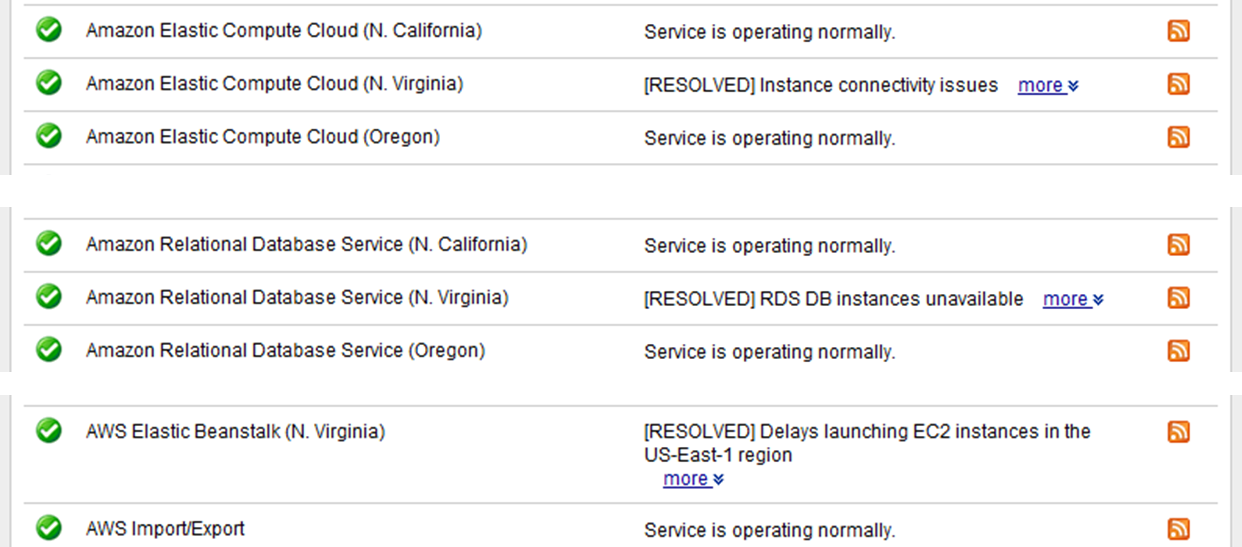
AWS Outage – Thoughts on Disaster Recovery Policies
AWS Outage – Thoughts on Disaster Recovery Policies
Simplifying the Building of Mobile Apps in the Cloud
Grazed from IT Business Edge. Author: Michael Vizard.
A lot of the developers trying to create mobile computing applications today don’t have a lot of experience with the backend server technologies needed to deploy a robust mobile computing application. And yet, when you look at the backend services required for any mobile computing application, they tend to be very similar.
Applicasa has turned that realization into a cloud-based service that masks all the complexity associated with building and deploying databases for mobile computing applications. The Applicasa service presents developers with a drag-and-drop interface for creating the database and custom queries in about 10 minutes. Once database objects and queries have been set up, Applicasa generates a customized software development kit that converts database objects to the native development environment without requiring manual coding…